The most important discipline for understanding where AI is headed isn't computer science, it's economics.
For a decade, we asked one question: what can a single model do? Could it write Python, pass the bar, translate a dead language. We wanted one entity to hold every skill in its parametric memory and produce an answer in a single forward pass. That means one shot at calculation, there's no pausing to check a database, and no revising a draft.
That made sense when models were scarce and expensive. When you can only afford one massive instance, you optimize that instance. It's the same logic as monolithic software in the early 2000s: one giant codebase, everything crammed inside. It's as if we were hunting for a superhero.
The new question is how work divides
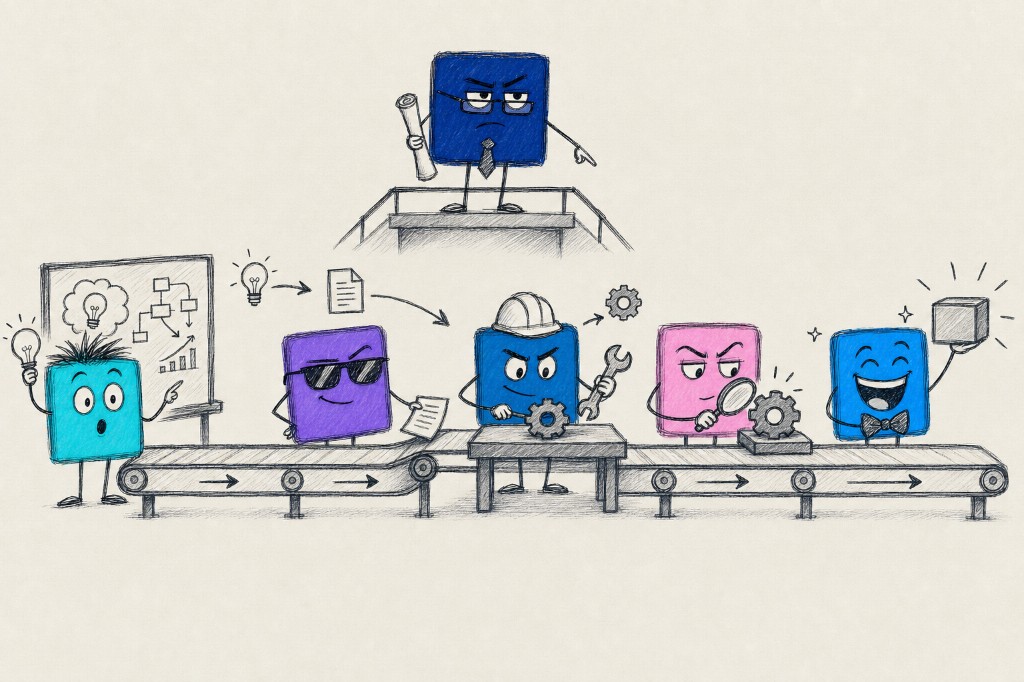
Modern production systems don't lean on one oracle. They split cognitive labor across what I've identified as three primary roles.
Orchestrators are the managers. Reasoning-heavy models whose job isn't execution, it's planning. They take an ambiguous goal, break it into a graph of dependencies, and route the work.
Workers are the specialists. Smaller, cheaper models tuned for one task: extracting entities, formatting payloads, summarizing a page. Not brilliant across the board, but fast and a fraction of the cost.
Tools are how the system touches reality. Search APIs, SQL engines, sandboxed interpreters. A worker doesn't just ask a question, it writes a script, hits the API, reads the error code when it hits a rate limit, waits, and retries. It debugs its own process on the fly.
Ask this system for a 10-page investment thesis on EV battery supply chains and the orchestrator doesn't hallucinate from two-year-old training data. It maps the dependencies, dispatches one worker for live sales data and another for geopolitical news, validates what comes back, then drafts. The system doesn't rely on what a model memorized. It reasons, retrieves, and synthesizes in real time.
The bottleneck isn't intelligence. It's coordination.
Anyone who has run a team knows communication overhead can kill a project. Same here, except the cost is literal compute. Every delegation duplicates context. Delegate to five workers and you pay for that context window five times. Every validation loop burns tokens. Every timed-out API call stalls the chain. And a worker that hallucinates one number can propagate that error straight into the final deliverable unless another model checks its work first.
So the discipline has changed. The best builders aren't tweaking weights to make a model marginally smarter, they're designing workflow topologies, they're answering "how do we route cognitive work through specialized agents without losing fidelity?" or "how do we prevent them from blowing their token budgets?"
When done right, a fleet of small, cheap models beats a trillion-parameter monolith on less total compute.
This is Adam Smith, not Transformers
Before the factory, a cobbler did everything: measured the foot, tanned the leather, cut, stitched, sold. Output was scarce and expensive and the assembly line broke that apart. One worker cuts, another hammers, each with specialized tools, and a floor manager keeps the material flowing to the right station at the right moment.
We're applying the division of labor to cognition. Small models have a comparative advantage in speed and cost, while big models have it in complex reasoning and routing. And like any real economy, the limiting factor is transaction cost. If calling a worker costs more in tokens and latency than the orchestrator just doing it, the topology breaks. That's Coase's theorem running live in production: a firm expands exactly when coordinating an outsider costs more than doing it inside.
What this means for integrating AI
You don't need a PhD in machine learning to grasp modern AI, you need to understand how teams work. Divide the project, assign roles by who's best at what, and manage the overhead of keeping everyone aligned. Simply put, agentic orchestration is the automation of that delegation.
The advantage now goes to systems architects, workflow designers, and people who intuitively understand organizational behavior and microeconomics. You can have the best worker model in the world, but drop it into a badly designed cognitive factory and the whole thing fails.
One question worth sitting with. Today, humans design these topologies. We set up the graphs, define the roles, weigh the token spend. Soon the orchestrators will optimize their own topologies. When the thing making microeconomic decisions about how to divide, assign, and value cognitive labor is itself an AI, it stops being a tool and becomes a manager.
If economics is the discipline that best explains AI, then AI will eventually start rewriting economics.